 The Statue of Liberty National Monument officially celebrated her 100th birthday on October 28, 1986. The people of France gave the Statue to the people of the United States over one hundred years ago in recognition of the friendship established during the American Revolution. Over the years, the Statue of Liberty's symbolism has grown to include freedom and democracy as well as this international friendship.
Sculptor Frederic Auguste Bartholdi was commissioned to design a sculpture with the year 1876 in mind for completion, to commemorate the centennial of the American Declaration of Independence. The Statue was a joint effort between America and France and it was agreed upon that the American people were to build the pedestal, and the French people were responsible for the Statue and its assembly here in the United States. However, lack of funds was a problem on both sides of the Atlantic Ocean. In France, public fees, various forms of entertainment, and a lottery were among the methods used to raise funds. In the United States, benefit theatrical events, art exhibitions, auctions and prize fights assisted in providing needed funds.
Meanwhile in France, Bartholdi required the assistance of an engineer to address structural issues associated with designing such a colossal copper sculpture. Alexandre Gustave Eiffel (designer of the Eiffel Tower) was commissioned to design the massive iron pylon and secondary skeletal framework which allows the Statue's copper skin to move independently yet stand upright. Back in America, fund raising for the pedestal was going particularly slowly, so Joseph Pulitzer (noted for the Pulitzer Prize) opened up the editorial pages of his newspaper, "The World" to support the fund raising effort. Pulitzer used his newspaper to criticize both the rich who had failed to finance the pedestal construction and the middle class who were content to rely upon the wealthy to provide the funds. Pulitzer's campaign of harsh criticism was successful in motivating the people of America to donate.

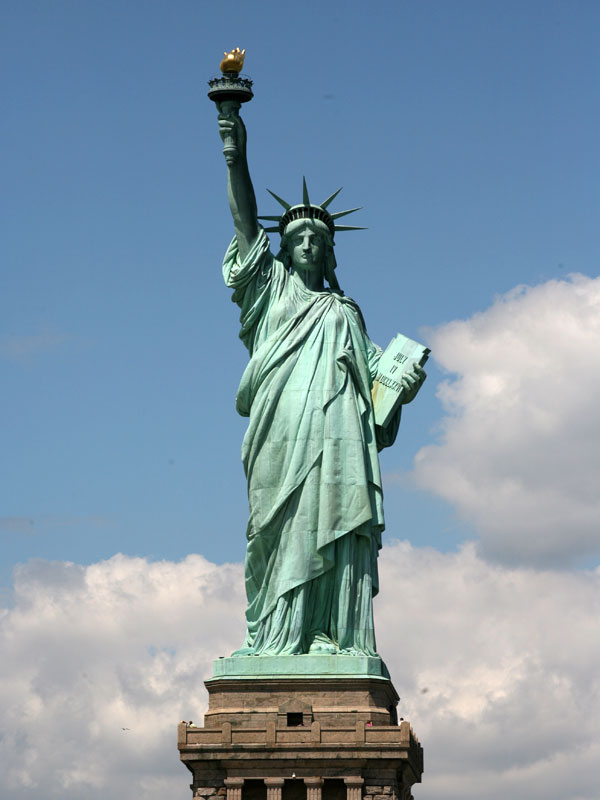 Statue of Liberty is on Liberty Island (born Liberty Island), about 3 km south-west of the southern tip of Manhattan, one of the boroughs of New York. Until 1956 the island was called “island Bedlou” (born Bedloe’s Island), though popularly called the “island of freedom” since the beginning of XX century.
Goddess of Liberty holds a torch in his right hand and a plate on the left. The inscription on the plate reads “English. JULY IV MDCCLXXVI »(« July 4, 1776 “), date of signing of the Declaration of Independence. One foot “Freedom” is on the broken chains.
Visitors are coming up to 356 steps to the crown of the statue of liberty or 192 steps to the top of the pedestal. In the corona, there are 25 windows, which symbolize the earthly and heavenly gems rays illuminate the world. The seven rays on the crown of the statue symbolize the seven seas and seven continents (the western geographical tradition has it the 7 continents).
The total weight of copper, used for tide statue – 31 ton, and the total weight of its steel structure – 125 tons. The total weight of the cement foundation – 27 thousand tons. The thickness of the copper covering of the statue – 2,37 mm. Height from ground to tip of torch – 93 meters, including base and pedestal. Height of the statue, from the top of the pedestal to the torch – 46 meters.
The statue was constructed of thin sheets of copper, minted in wooden forms. The formed sheets were then mounted on a steel frame. The idea of creating a statue of the centenary of American independence, noted in 1876, attributed to the French writer Edouard de Laboulaye, believing that a prisoner in 1778, the alliance between France and the United States should properly immortalized. Eiffel brilliantly developed the iron skeleton, and Bartholdy “dressed” in his forged copper sheets 3 mm thick, fixed to the frame bolts.
On the ferry going to the Liberty Island, almost always worth all, and even more foremost within the statue, so the elevator can accommodate only a few people (there are stairs). The observation deck at the top of the pedestal is located at a height of 10-storey building, and there could clearly see all the landmarks of the surrounding area. The most energetic and physically fit can climb another 12 floors (168 steps) to the crown, but the torch lifted up to 93 m above sea level, is open to visitors.


